3D-based Captchas become reality | Crave - CNET
I'm fascinated by the idea of the CAPTCHA. Not the least of which, is the fact the CAPTCHA is an acronym. Because of the continuing risk/reward systems that all humans operate under, this convention is most probably here to stay.
What's funny to me regarding this 3D addition, is that in order to work around the system one of two things will need to happen.
1.) Spammers hire a person to do the work (and in that case, the CAPTCHA actually does exactly what it is intended to do: ensure a human is using the system.
2.) Computers are programmed to better recognize three dimensional objects from virtually any angle.
Option 2 is what intrigues me. I have to believe that someone is already working on this problem. Allbeit for use in robotics applications. If the spammers and hackers of the world decide to spend their time on option 2, the system will need to evolve again. Only this time we will have added the concept of computers recognizing three dimensional objects in the process. A process that we will need to have at somepoint in the future.
This has got me thinking, what other kinds of difficult computer recognition problems are out there? The best I can come up with at the moment is idiomatic expressions. The other problems I can come up with are already being worked on, or they've been solved (voice recognition and facial expressions recognition).
As a society we need to find ways to put value to the problems that we may hackers work on more valuable. These people spend loads of time working on a problem, so, let's give them a problem that really needs to be solved.
Saturday, March 28, 2009

Saturday, January 24, 2009
There are no new ideas
If you spend any time around me, you’ll hear me say this phrase somewhat regularly. As I have now been working in the IT industry for 10 full years, obtained a Bachelor’s degree in Business Computer Information Systems and a Master’s degree in Information Technology, it becomes more and more clear to me that there are no new ideas, only a new way to implement the same old ones.
For instance, take ERP system such as SAP and PeopleSoft. There is absolutely nothing new about putting your business information into a computer. In fact, the only new about the an ERP system is that is has more information available, in a shorter period of time, and in a way that people can understand. Hmm, that sounds a bit like a chart… more information available, short time, more people can understand…. exactly.
The same goes for the various kinds of computers systems that run today corporations and small business. 30 years ago we talked about virtualization on the mainframe, and now we talk about on mid-range or mini-computers. Still virtualization, still the same old making one computer look like or act like many computers at the same time.
I find that extraordinary. So, really, the big ideas are not new, only new ways to implement the same old ideas that have already been proven successful decades, centuries or millennia ago.
Saturday, January 10, 2009
Master of Information Technologies
After completing my Master of IT in May of 2008, I’ve now had some time to reflect back on both the experience and it’s implication for my daily work as an IT professional.
Probably the most startling revelation that I take away from the experience is that most IT people are IT because of the technical interest. That IT is any help at all to the BUSINESS, is only coincidental. As IT people, struggling with the bits and bytes, we sometimes loose sight of what all our efforts are for.
If IT people fail to see how IT can help the business, we’re all doomed to failure. We must, as individuals, departments, divisions and companies understand how IT is critical to the business (whatever business that may be) and strive to find how IT can serve and not be served.
Tuesday, June 24, 2008
Monday, June 25, 2007
Building Websites - Screen Resolution
Why does my site look like X when I view it on one computer, and like Y when I view it on another computer?
The answer is likely to be screen resolution.
Many times when I get the opportunity to sit down with a client and discuss their website, screen resolution is discussed more often than not. Screen resolution is so frequently discussed in meetings that it's time for me to do a write up, so that I can use it as a reference later. I figured that if I'm going to write it up, that I might as well put it on the blog so that perhaps someone else could benefit from it as well.
What is Screen Resolution?
Screen resolution is usually a user controlled setting that controls how may pixels can be represented on a screen at any given time. The most common misconception I see with screen resolution is that it has something to do with the physical size of the monitor. Let me be clear, monitor size has nothing to do with the screen resolution.
Why is Screen Resolution an issue?
Screen Resolution affects how much area a website will fill on a given screen. If you are using a low resolution (e.g. 800 x 600), you will only see about 800 pixels horizontally on your screen. Many websites are built to fit horizontally into an 800 x 600 resolution screen. If you are using a resolution higher than 800 x 600, and the site is built to horizontally fit into an 800 x 600 resolution screen, there will be extra space on either or both sides of the website. In some cases, a site has been constructed to fill the screen regardless of the screen resolution. This is the ultimate goal with any site design, however, not every design can be made to function this way.
For example, obchinc.com, is made to fill the screen regardless of resolution, in contrast, fredlemire.com, is built to fit in the browser window of an 800 x 600 pixel resolution display.
There are many ways to deal with the screen resolution issue. Many technology related sites has elected to build their sites to fill up the screen real estate on a much larger display. This is a problem if you are using a display with lower resolution. If your display is using a lower resolution than the one the site was intended for, you will see horizontal scroll bar appear on the screen, so that you will be able to see the whole site.

Thursday, June 21, 2007
SeeDragon/Photosynth demo
This is incredible. Amazing. The conglomeration of social interaction and exploration accessible to anyone. This is web 3.0, the semantic web in the making. Thanks to Tim Fehlmen (DailyCupofTech.com) for posting this one his blog for me to find!
Tuesday, June 05, 2007
How Online Criminals Make Themselves Tough to Find, Near Impossible to Nab - CIO.com - Business Technology Leadership
How Online Criminals Make Themselves Tough to Find, Near Impossible to Nab - CIO.com - Business Technology Leadership
This is a really great article about online crime. Today, identity theft is a major problem, and law enforcement lacks the resources, tools, manpower and time to deal wit identity theft properly. This is just more indication that identity theft or data that is really a matter of time... not if, but when.
This is a really great article about online crime. Today, identity theft is a major problem, and law enforcement lacks the resources, tools, manpower and time to deal wit identity theft properly. This is just more indication that identity theft or data that is really a matter of time... not if, but when.
Wednesday, May 16, 2007
Optimus Maximus keyboard
Optimus Maximus keyboard

Wildly Expensive. Amazingly Functional. The future of keyboard evolution. The Optimius Maximus keyboard has a very appropriate name. It's a work of art, but, just like great art, you pay a high price. This keyboard weighs in a about $1500. What's so different about it that makes it work $1500? Every key on this keyboard is a small OLED screen. You can change the keys display. Say you want to type in chinese. No problem. A new keyboard layout? sure.
Many people have seen and used keyboards on touch screens. You may have even seen the infrared keyboard projector for a palm or handheld device. But this is different. For me, it's all about tactile feedback. I want a button that depresses so that I can tell I have actually activated the key. Software keys just don't offer the kind of touch feedback I need.
Perhaps not now, but someday in the future, I can definitely see more and more new and innovative interface products. Because, the reality is, not everything can be done with voice commands, somethings are just meant for the keyboard.
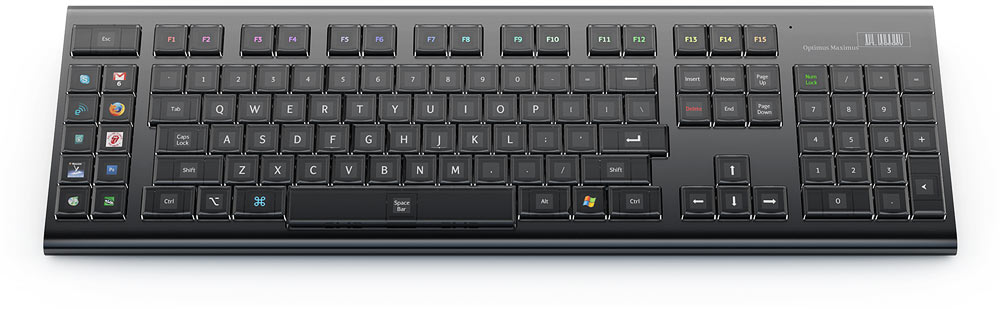
Wildly Expensive. Amazingly Functional. The future of keyboard evolution. The Optimius Maximus keyboard has a very appropriate name. It's a work of art, but, just like great art, you pay a high price. This keyboard weighs in a about $1500. What's so different about it that makes it work $1500? Every key on this keyboard is a small OLED screen. You can change the keys display. Say you want to type in chinese. No problem. A new keyboard layout? sure.
Many people have seen and used keyboards on touch screens. You may have even seen the infrared keyboard projector for a palm or handheld device. But this is different. For me, it's all about tactile feedback. I want a button that depresses so that I can tell I have actually activated the key. Software keys just don't offer the kind of touch feedback I need.
Perhaps not now, but someday in the future, I can definitely see more and more new and innovative interface products. Because, the reality is, not everything can be done with voice commands, somethings are just meant for the keyboard.
Friday, April 13, 2007
What Ultra Mobile PCs look like to Intel
It's always an interesting thing to see what's in store for tomorrow consumer electronics. I am especially excited about this video intel has put out about the future of mobile computing. Take a look for yourself.
The truth is, that computing is everywhere, GPS, DVD, digital audio, cell phones, watches. Just about everything has some form of computer chip to assist it's functionality in some way. Intel has these multifunction devices laid out for our future, and so far it looks pretty cool. Only time will tell.
The truth is, that computing is everywhere, GPS, DVD, digital audio, cell phones, watches. Just about everything has some form of computer chip to assist it's functionality in some way. Intel has these multifunction devices laid out for our future, and so far it looks pretty cool. Only time will tell.
Tuesday, April 10, 2007
YouTube - NY Drift - Google Earth 3D
I was enjoying a Google Earth video earlier today and it got me thinking. What kinds of new things will become of this kind of software? With the new availability of 3d building and rendering software in a short period of time we will have built a virtual world quite literally. You'll be asking yourself.... "Is it real, or is it Memorex?" But seriously, we're well on our way to world tourism at your desk. As the video demonstrates, the possibilities just for architecture are huge. You can build you house and see it in 3d inside and out before the foundation is laid. Just last week I found a website that will let you track a commercial flight in Google Earth, in near real time.
Subscribe to:
Posts (Atom)